


One of the biggest priorities for the Memphis Grizzlies this offseason was to find some contingency for Zach Edey. While the second-year center was dominant when he suited up, he only played 11 games and has had multiple procedures on his ankles since the end of his rookie season. Factoring in his recent injury history with his 7’4”, 300-pound frame, there’s reason to be concerned.
The Grizzlies addressed it this offseason with multiple acquisitions. It felt a bit inevitable that the Grizzlies would target a veteran big man, then a rookie to develop. Instead, they traded for Isaiah Stewart with second-round picks generated from a trade-down with the Pistons. They reportedly signed Carson Cooper to a two-way contract. They also swiped Quinten Post from the Golden State Warriors via restricted free agency.
I wasn’t totally sure about Post as a potential target due to his restricted free agency — shoutout friend of the platform, Chris Herrington, for identifying Post as a possibility. The last time a restricted free agency was poached from a team via an offer sheet was with Bogdan Bogdanovic in 2020.
However, the Grizzlies capitalized on the Warriors’ salary cap situation, heightened through their pursuit for LeBron James. They created a quirky offer sheet with guarantees and incentives that would shrink the Warriors’ flexibility.


It was an offer the Warriors couldn’t match, so the Grizzlies acquired Post to round out their center depth. Post won’t be the splashiest free agent acquisition on the market. However, he has a sound, unique skillset for a big man, and he has the tools to flourish in Tuomas Iisalo’s system.
When assessing Post’s skillset, it’s easy to boil it down to 3-and-D, as his strengths come with his three-point shooting and his rim protection.
Post is one of the most prolific giant shooters in the league. It’s his skill that earned him minutes with the Warriors so quickly. His accuracy took a dip this past season, going from 40.8 to 33.6 percent from three. However, he’s a candidate to bounce back, given his track record in his rookie year and college — shot 42.6 and 43.1 percent from three in his final two years of college.
Post’s three-point flex is with his volume. This past season, he ranked 22nd in the league in three-point attempts per 100 possessions (11.6) — leading all seven-footers. This pace of shooting ranked fifth among all seven-footers in the three-point era, trailing just Lauri Markkanen (2024-25, 2023-24), Victor Wembanyama (2024-25), and Channing Frye (12.0).
He can deploy his shooting in multiple facets — pick-and-pop, spot-up in five-out spacing, and as a trailer. This past season, he shot 48 percent from three (24-50) as a pick-and-roll roll man, trailing only Kon Knueppel. He also shot 45 percent (9-19) from three off screens, often catching opposing bigs sleeping in various screening actions. Given the heavy influence of the Grizzlies’ 5-man playing out of the slot as a screener, Post’s three-point prowess should be a feature in the offense.
In conjunction with his shooting, he’s become a nice screener that can create space for his handlers and movers. In addition, his shooting gravity off screens provides extra spacing for handlers. Potential market inefficiency to target bigs that developed their screening in Golden State?
Post made strides as an interior defender. Although he doesn’t pop off in the blocks numbers — 1.4 blocks per 100 possessions in his career, 1.4 block percentage this past season, which is in the 42nd percentile among big men. However, he’s analytically a strong rim protector.
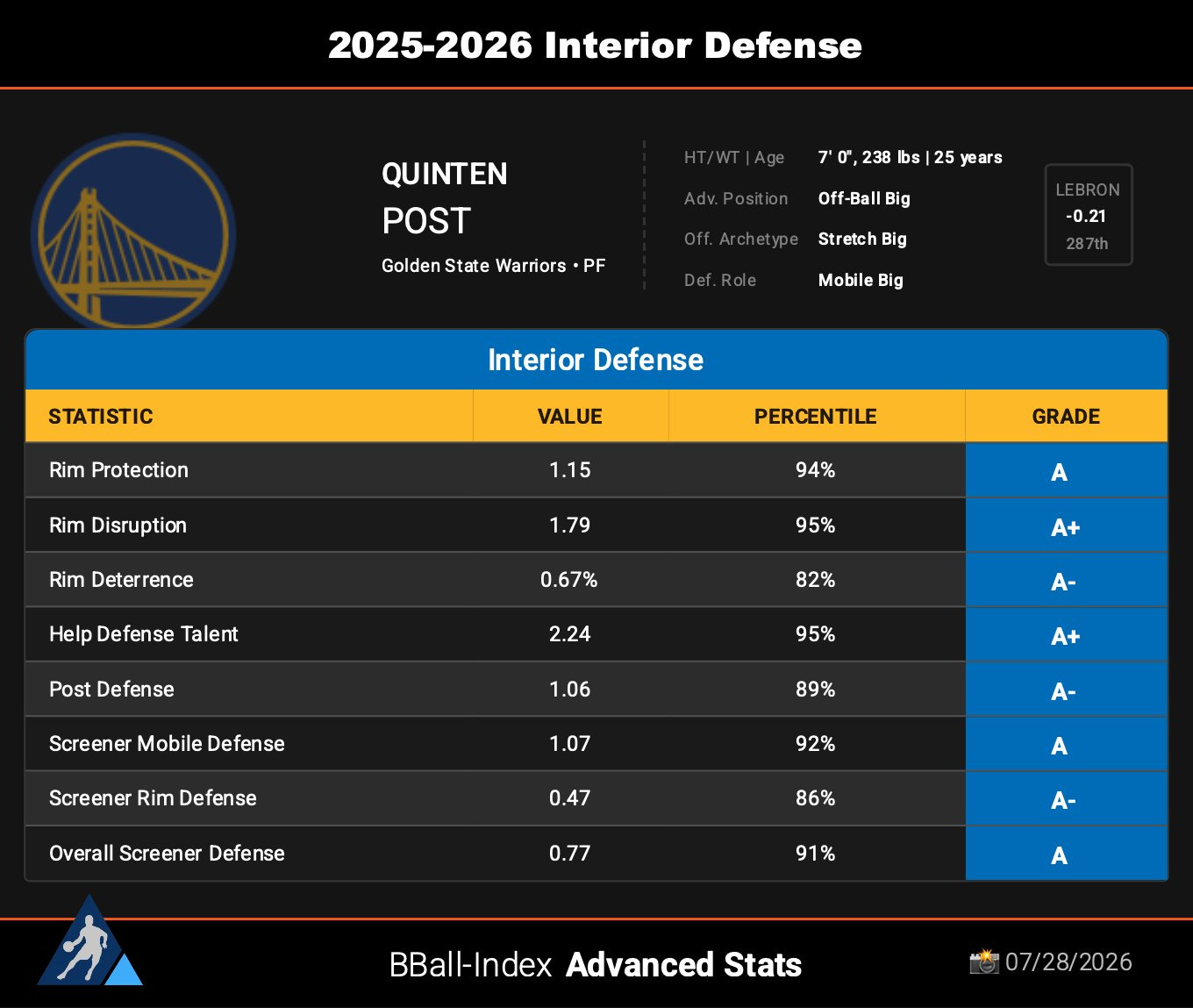
How does his rim protection pop in such a significant way with his low block rates? Post simply knows how to use his size. He demonstrates great verticality when protecting the rim, often rising up with both arms staying straight up — a technique that’s beneficial to avoiding fouls. He’s smart with his rotations on drives. He plays drop coverage pretty well, as he keeps great spacing between his man and the handler. While he’s not going to be an elite shot-blocker, his presence as a shot-alterer is definitely felt.
Post is primarily going to be a drop-coverage big. Let’s not get it twisted — this designation is met with polarization, when it really shouldn’t. Like most strengths and weaknesses, it’s about which trait outweighs the other. With Post’s drop coverage defense, he can be a bit susceptible in space, as he’s a bit heavy-footed. As a result, teams can find themselves with cleaner jumpers or advantages after beating him on a closeout.
When addressing other concerns as an anchor, Post is simply an okay rebounder. Per Cleaning the Glass, he has never had an offensive rebound rate off missed field goals higher than 6 percent — which trends towards the 20-26th percentile among bigs — and his defensive rebounding rate off missed field goals has hovered around 17 percent (often near the middle of the back among bigs). Lineup construction with positional rebounding is pivotal whenever Post is manning minutes at the 5.
Finally, I wanted to highlight two secondary skills: play-finishing and playmaking.
Post took major strides as a play-finisher this past season, as his field goal percentage at the rim increased from 51.7 to 68.4. His method of finishing around the basket depends on where he’s spaced. He’s a solid cutter, but his size makes him a massive target for dump-offs through drives.
Even with his finishing, he still needs to work on consistently going up stronger, which might have been a product of his poor efficiency as a rookie.
Finally, Post’s playmaking is a bit sneaky. He’s far from a hub or anything, but he’s not a non-passer either. Per Cleaning the Glass, he’s finished around the 62-63rd percentile in assist percentage among bigs — 12.4 percent his rookie year and 11.6 percent this past year. At Boston College, he tallied an assist percentage of 18.7, which was 8th among players 7’0” or taller since 2008. He can make reads out of interactions — pick-and-pop, give-and-go, short-roll. Because of his shooting, he forces rotations, which allows him to either attack the closeout for another read or to make the extra swing. Again, he’s not a hub, but I’m interested to see how Tuomas Iisalo taps into this skill.
Post’s 3-and-D skillset sets a clear foundation for his role on his team, but his standout production in these categories combined with his ancillary skills could be an amplifier when his number is called.
When listing out potential 10-man rotations, Post is typically out of the fray due to positional overlap with Zach Edey and Isaiah Stewart. However, he’s going to play. For starters, injuries happen, and I’d bet they exercise caution with Edey’s minutes. Secondly, over the past two seasons, the 5th “big” (mainly the guy behind the backup 4 and 5) has found a role on the Grizzlies.
Jay Huff played regularly in 2024-25, and Jock Landale had a more heightened role than anticipated because of injuries to Edey and the late Brandon Clarke.
Post can be seen as comparable to them. Post is more similar to Huff due to the high three-point volume. Huff’s shot-blocking numbers pop more, but Post is a sturdy anchor due to his mass. Landale is the superior rebounder, but his rim protection is a step behind either Post or Huff. If anything, Landale’s impact as a screener and shooter this past season should give a vision for how Post can be used.
Comparisons aren’t 1:1 though.
However, the Grizzlies leveraged their flexibility against another team’s tighter books to acquire a young player with a defined skillset and within a positional group that needs depth.
Quinten Post isn’t the splashiest offseason acquisition, but he may surprise people with his combination of shooting, rim protection, and subtle passing skill.
If you choose to support my Substack, SubTsakalidis, follow this link to my Allie’s Allies St. Jude fundraiser page. You can also support through buying SubTsakalidis merch — t-shirt, coozie, glass, coffee mug, stickers — with proceeds going to St. Jude Children’s Research Hospital. If you choose to become a paid subscriber, all proceeds will go towards St. Jude Children’s Research Hospital.
Could he play spot minutes next to Stewart in a two big alignment?